Beauty expresses good. We sense it when we see compassion, artisanship and often in nature. By it we judge what leads to life and what leads to death. Beauty informs our being, seen and unseen, and reaches the light within each of us taking us to a place within where we may sense joy and feel content.
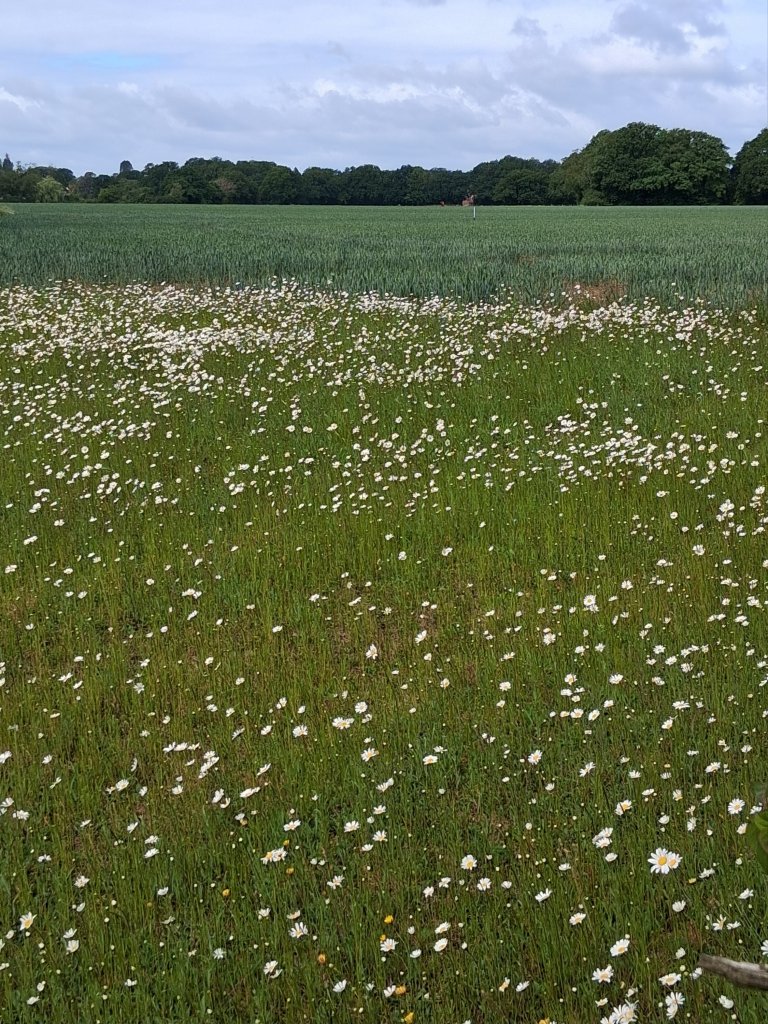
Notley John Raye way
Beauty is the place of peace, where we encounter justice and truth reigns. Jesus opens us to this way and leads us to a knowledge of God that transforms our being. His birth life and resurrection shows us a God who enters into creation and faces down evil. On the cross God confronts evil through the narrow way of peace; Jesus experiences death, the consequence of sin, though he never departed from the way of life. Jesus paid the price of Sin, and died. Evil did what only evil could do: violence. Jesus did what only good can do, transformed evil and violence, and defeated it by rising from the dead to new life. Beauty open’s our eyes to resurrection, we are people of the resurrection looking for resurrection in our lives, a people of hope. Through the resurrection hope we receive hope and can look on beauty renewed. We can see.
As we obey the leadings of beauty, beauty opens our eyes to the salvation that is in Jesus the Christ. We come to understand the depths of death, the sin that separates us from life. In peace, humility and contrition we are transformed from glory to glory in the face of evil: all is well and all is made well. We chose life and receive the grace of peace.
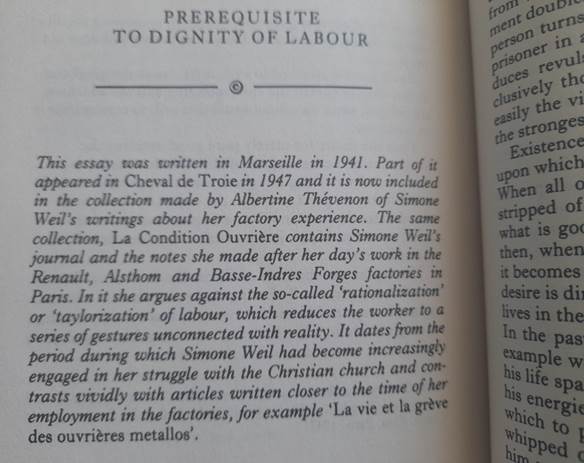
All of us suffer, and we all toil. Simone Weil points out that a great artist becomes more skilled, a business man becomes more wealthy and a politician gains more power as they succeed in their careers and they move on to greater things. For each a moving on brings wealth and renown on their field. A worker, a teacher, a farmer, remain in their toil, getting better at it brings no reward, and they can only move on by leaving their trade. For most of us there will be little scope for improvement in our lot unless we change jobs and it may be more of the same as we are subject to redundancy. We may even go backwards.
For most of the world, living from hand to mouth is their lot and we hope that the world will be fair to us and we will have clothes, food, good health and shelter. We also hope for justice, safety and the opportunity to learn.
We learn that this works when our community functions benevolently and that we are part of a community of communities that supports the individual and works towards the collective good.
A supermarket can model this being a placewhere communities intersect. It sells food, clothes and luxuries, and not only thrives at the price point, but succeeds when its staff is content and outward facing and the customers feel part of the whole, believing that all that they have has been produced and provided with kindness. Each of us trusts that no harm has been done and that care is taken so that the weak are provided for. Social capital and loyalty grow if allowed to and the supermarket prospers. It isn’t engineered it is a function of time and place. The store is a modern focus of communities and actually in the common mind held accountable to the common good. This may be a fiction but you see tokens collected for charity, food bank collections and innovations in waste disposal that benefit the locality. Local charities collect at the doors and family and friends gather for coffee. The superstore has become the market centre, which town centres struggle to retain.
Luxury items may be beyond the means of the workers who make them, the meal beyond the purse of the chef, the car beyond the wage of the chauffeur, the lifestyle choice beyond the salesperson.
All the worker can rest in is the the sense of having toiled well, a means to a greater end of having been good and faithful, or avoided penury. If our lot confines our purse but we are necessary to a function of wealth, we can also be happy if we feel part of something beautiful. Our participation brings us joy.
Beautiful things may be of immense value and costly. Refinement and detail has a price and wealth enables great artistry. For most fabricators, the high end taylor, the super car engineer, what they work on is beyond their purse yet without their skill there is no product. That is the nature of our culture; our wage is there because we serve other’s needs. We depend on what we produce. Our labour enriches our customers, our managers as well as ourselves in an organic system fulfilling grades of need. Even people of ideas need others to buy into them and pay.
We are not owned by others but we sell our labour, peddle our skills, and depend on the market to monetise our efforts. We may shy from calling customers our masters but in selling our labour we are always close to selling ourselves. By design the beauty that everything we make reflects, cannot be bought and is open to all and can result in wonder or envy.
Simone Weil points to beauty in the stars, architecture and liturgy, family and holidays. All nature is telling us something, darkness brings light and yes evil hides behind wonder and pretends to be light, but beauty is eternal, envy, jealousy and pride bring death. The consequences of evil persist and their cycle seem unending but as they bring death, if they are not fueled, they too die. Goodness brings their demise sooner.
Further, look at the life cycle of the large blue butterfly, an adult of great beauty whose caterpillar destroys a flower, drops to the ground and depends on tricking red ants into caring for it as a pupa which eventually eats the whole ant colony before becoming a chrysalis and emerging as an adult of great beauty.
Depending on our viewpoint this is horrific as a process or beautiful in its outcome. The butterfly is a parasite, its lifecycle intricate. Beauty depends on your gaze, the truth you hold. The butterfly is indeed beautiful. The lifecycle is in truth fascinating. Seeing the whole covers the detail.
Negotiating the path of life between suffering and plenty demands joy to draw us forward into right seeing. There has to be an eternal covering of all that holds us to the grind stone, envy and jealousy, a stopping and looking to take in the beauty that will remain with us forever. Joy draws us to this and enables us to be content, beholding a beauty all may see, and expand our gaze. We must strive to enable joy to work its alure, I suggest, and lead us along the narrow way that leads to life, to see beauty, truth and good and enjoy life as we are able. The gift I am coming to see is in the moment, the surprise of centering joy. Beauty takes its place on the throne of our hearts and can be shared in the most desperate of circumstances. This beauty is shared by all and binds us together in love. The truth of our way is made plane in love that draws on the ineffable and speaks through kindness and care, compassion and just action. Good times for all.
Ecclesiastes 2:24-26 NRSV
There is nothing better for mortals than to eat and drink, and find enjoyment in their toil. This also, I saw, is from the hand of God; for apart from him who can eat or who can have enjoyment? For to the one who pleases him God gives wisdom and knowledge and joy; but to the sinner he gives the work of gathering and heaping, only to give to one who pleases God. This also is vanity and a chasing after wind.
Power has at least two ways of working, by force or by persuasion. In the greek, Mark Vernon tells us there are two words (or four) most used for power in the bible, and the one used of Jesus (dunamis) is the power that flows and draws; the power in love, beauty and truth. The other word is the power of authority (exousia), the power of the powers in this earth that exert authority.
I have followed Mark from science cleric to atheist to Buddhist back to mystic Christian. It has always been at a distance, but recently, he has started making more sense.
In this podcast, he ends by critiquing Christianity as falling into the law based authority camp or the camp that grasps at the draw of beauty, the finaty, and finds the eternal. He is drawn to places, to people, and liturgy, that are alluring rather than compel.
Auguries of Innocence
By William Blake
To see a world in a grain of sand And a heaven in a wild flower, Hold infinity in the palm of your hand And eternity in an hour.
Auguries are portends or foretellings so the poem looks at the humanity that reacts to hurt and sees it as pointing forward to innocence or maybe to a restoration of innocence. Compassio then points to an other, draws us to innocence, our reactions to injustice, the caging of the beautiful and hamstringing of the strong point to a purer humanity. They draw us to beauty, truth and good.

 M Emlyn Humphries