Tag Archives: belief

Reflection from a Week in April 2016 on sovereignty and free will.

I have written, thought and spoken a lot of my belief in God’s gift to us of a sovereign will. I think I believe it is this free gift to us – God’s grace to us – that makes us humans in the image of God. Our sovereign free will is God’s image in us, a principal of grace. God has perfect free will. What we contend for and call our free will is truly slavery; slavery to guilt and shame; slavery to the drives of our lusts and desires.

OLYMPUS DIGITAL CAMERA

Audley End Hot House Display

It has been said that joy craves eternity and others say that eternity is to be found in the moment, living the moment to the full. I am sure there is some truth in this. This is always expressed in the context of our ability to choose. But how do we effect this choice. Is the fact of our faith in our own will in reality binding us to a law, and this in fact is the source of our sin in turning from the grace set in each of us. We are not who we are created to be; sin then is not living as those who are sovereign by God’s will but by a principle of law, the knowledge of good and evil.

Is the existence of law the fruit of the tree of the knowledge of good and evil? Law is the masking of our created godliness; a denying of the gift of grace within all of us. What does it mean in Genesis 3:22…”The man has now become like one of us, knowing good and evil. He must not be allowed to reach out his hand and take also from the tree of life and eat and live for ever.” And in Genesis 11:6… “If as one people speaking the same language they have begun to do this, then nothing they plan to do will be impossible for them”

Is God jealous for his deity? Why then had he made man in his own image? Isn’t becoming more like God progress?

I wonder if, given that God is supremely good and named as Love, it’s the truth that the sovereignty of our own will is only evil if it is not the perfect expression of the perfect will of God. It is a grasping of who we are made to be in our own will on our own terms.

Adam’s grasping after and taking of the apple asserted his will, not the will of God. Adam creates a morality not inherent in the grace of human sovereignty but in knowledge; in the death and curse of the law, creating a law; in judgement: this is good- this is evil. It is this principle of death Christ destroys, crushing under his foot.

Could it be that in Christ, the exact image and revelation of God, we see the law and its curse nailed to a Cross, the awful expression of Jesus’ living the life expressing, “Your will, not mine” to God his Father? The Cross is a powerful undoing of the power of the law, redeeming the grace within us.

I wonder if the story of the Bible is God’s revelation of the absolute value of his image in us. We measure our freedom in our ability to choose, but could it be that God is leading us to a place where we live from that inner place of sovereign grace.

I return again to the absurdity of this story. It begins in the very act of creation where we measure our being by the ultimate Being, God, and in the despair of sin we cry out, “Why did you create me for such suffering? Is that Justice?” Through Noah we see God’s commitment to humanity; to bear the pain of creation.

It continues in Abraham where God’s promised one is demanded as a sacrifice – a call from God to break all laws. A Call from God to have faith in God to be a god who he is not – a child killer – demanding what he has himself forbidden. Is the deep lesson here that all morality is within us and is perfected in trusting in the grace within us – our only source of Joy and Delight is being in communion with God’s perfect will? Is God saying in this that there is a higher purpose, a higher calling that we are to realise; that which is within us, beyond what we can conceive as being good and evil, beyond what we can conceive as being God.

By pushing beyond our own judgement, we become who we are created to be; who Abraham is – our father in faith – and discover who God is. God is revealed. And then the incarnation, life and death of Christ – God on the cross with all its manifold meaning presents itself. What is the outcome? We stand in the presence of the living God and partake in his deity, living in communion with the Spirit through grace.

OLYMPUS DIGITAL CAMERA

Audley End a Riot of Tulips


It is a strange place to be where our high conception of God’s sovereignty makes God less than he is. We come to believe that God has destined everyone’s ultimate destiny and created us either for damnation or glory as an act of his sovereign will. Our freedom is to choose the course of our lives which in some mysterious way only confirms God’s un-resistible grace choice of us. We proclaim God to have known us from the beginning, conceived us in love and given us sanctity by knitting us together in our mother’s womb but, for the praise of his glory, he has created some whose unchangeable destiny is to suffer eternal conscious torment.

Anyone who counters this doctrine is called filthy and described as baying like animals.

But this idea of being destined for eternal punishment is abhorrent. For people who come to know God but accept this theory, they become what they dismiss – Universalists, believing all are saved- all are created for glory and in their heart of hearts they believe this but speak something else. We all deserve eternal punishment but some are chosen not by merit but for the glory of God’s grace.  In believing this I confess one thing with my mouth and hope the contrary becoming double minded and ineffective in proclaiming Christ as good news. When this movement of thought focusses on mission and service, it somehow grasps at assurance through works; the very works it denies are effective. God is truly only satisfied in Christ – his whole delight in humanity is not in works but in faith. So faith transforms itself into works that give us the solace, that we are elect.

For me the error is in trying to understand the Cross from the perspective of judgement and not on the realisation of grace, resurrecting the very principle the Cross destroys. Our election in Christ is because of our original grace. Our alienation from God, from the beginning, is because we choose law and reject grace, preferring a principle of morality over the work of grace of the indwelling Spirit.

Any reading of the Bible calls us to intimacy with God, not the comfort of our own theories. By appealing to God as a judge we make God unjust and, in our hearts, fear his justice, secretly denying God the power to judge, if we think it through. This idol of our theory of God’s sovereignty saps our humanity and our very words are tinged with a monstrous intent. We become a mouthpiece of a god who is not God. We do not find Christ in the Bible. We cry out to the god of our own conceiving, “Where is the justice!” We have made an attribute of God our idol.

OLYMPUS DIGITAL CAMERA

Audley End Potting Shed

I heard a thing that was strange to me – the idea that on the cross we see that violence does not succeed. The cross says to the principalities and powers, all your vengeance, all your cruelty, all your measure for measure is defeated. Your vindictive acts – your solutions to all problems, killing, maiming, shaming – are defeated. The hypocrisy of the accusers and cruelty of the oppressors are exposed and defeated. Nothing separates us from the love of God, because on the cross, Father, Son and Spirit defeat death and even the wrath of God- his judgement on sin doesn’t extinguish the light of life.

I realised the urgency of Paul in his letters. I became aware that his message was to persevere in the face of accusation and oppression because of the cross and, no, you are not defeated! All because of your faith in the Cross… In all circumstances believe and hold to the Way and trust in Christ’s righteousness as your righteousness.
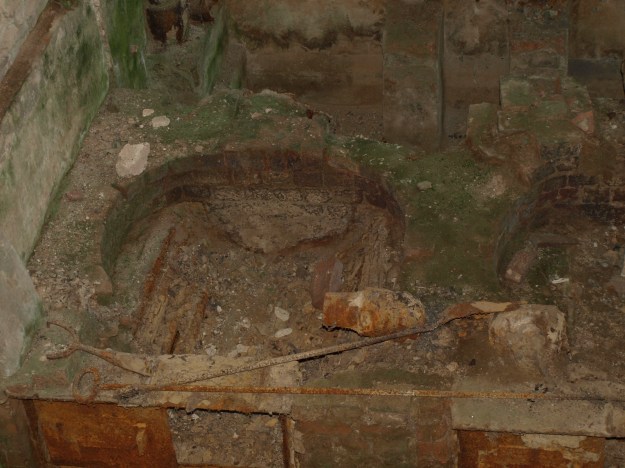
OLYMPUS DIGITAL CAMERA

Audley End Hot House Furnace

We live in a universe of time, gravity, chance and attrition. The light of life pierces this darkness. Light and life are attributes of our God, creator of a system where everything decays, where entropy dissipates and light brings new life into a system.

None of this has a moral character but God is God and he knows good and evil we are told. Our existence as bearers of God’s sovereign image, and in some way, the principalities and powers, makes the universe a moral universe. We are created from the beginning to walk with God, to know his voice and to serve in light and life, stewarding the gift of creation. And it was good – it is very good. This is our original blessing.

The revelation of God in the Bible is our Ararat, our Moriah, our Red Sea, the Incarnation, the Transfiguration, Calvary, Ascension and Pentecost – all beautiful. Personal.

Suffering is with us as is sovereignty and we are called to trust, to realise the original blessing in faith and know the sovereign power of our creation – to heal the sick, raise the dead and live free.

OLYMPUS DIGITAL CAMERA

Audley End Cloud Hedge

When Jesus declares the blessing, “Blessed are the poor in spirit… “ I wonder if we are slightly bemused – being poor in any way is not a blessing.

I wonder if the message is a glimpse of God’s view of suffering. We are all blessed. We are blessed in our being and God’s assured blessing works through all these troubles. Truly in creation we are good – God knows us from the beginning. Those who would marginalise and reject the lowly, the mourning, the peace makers, basically the losers in society, need to hear and see that all bear God’s blessing. The beginning is God’s blessing.

We are created in the image of God and in Christ we see the exact image of God though human like us. Christ is God and God is Father, Spirit and Son. God draws us into himself so that we know him because we are like him. Jesus humbled himself on the Cross and our troubled circumstances are given meaning in his suffering.

God himself takes the wrath and curse upon himself and dies in our place. Our faith is that his victory over death- his suffering and death – brings victory in our lives as he walks free from the last and greatest enemy, death. We follow and are made free to live, alive in the image of God, Father, Son and Spirit, dwelling in us- abiding within us – enabling us to live the good and perfect will of the Father. This is freewill in deed, to know and live from the perfect will of God; Christ within is our hope of glory.

God wants us to break through – he wants us to realise the blessing of creation – we are good. We are very good. God empowers us to put down sin and put on his righteousness turning away from our wilfulness and with Jesus, proclaim the Way, Truth and Life of Jesus; Father! Your will not mine!

We do well to study this, meditate upon this and listen to God in prayer. To pray at all times and in every way so that we can know and live the perfect will of the Father.

This is how we stand assured before the unapproachable light of God. This is how our weakness becomes strength. Truly, truly, truly, we are blessed.
Behold Behemoth!

photo (2)

The wounded healer is a book written by Henri JM Nouwen. The cover states, “In our woundedness, we can become a source of life for others.” The book is part of Nouwen’s teaching on Ministry. He concludes in a chapter on Ministry for a Rootless Generation, that the man of prayer offers leadership as an articulator of inner events, compassion and as a contemplative.

I really get this; Jesus taught us to love others as we love ourselves; he wept at the death of Lazarus, had compassion on the widow whose son had died and raised them form death as he did the ruler’s little daughter. He also withdrew often to pray alone.

It is so important we grow to love ourselves and know our inner depths; to know and love ourselves as God loves us. In loving God, wells of living water flow from our hearts – we are enabled to love ourselves. This is a revelation from the mouth of Jesus, recalling the creational joy of God at creation and the foundation of the saving word he gave to his people through Moses.

In loving God and loving one another as ourselves, we are able to redeem our times through Jesus. Those who are able to dig deep and articulate this love in a place of engagement with people, are able to lead. God poured himself out for us; as we pour ourselves out, taking our woundedness and rootlessness and articulating the miracle of our own healing in Christ, we offer leadership to our contemporary culture.  Leaders need to engage with and articulate their redemption.

Stemming from this articulating of the good news of Jesus, is a genuine compassion that breaks down walls; removes barriers; refuses to act to separate people from people. The suffering of others is our suffering, as much as our own pain.

The pain and violence that God chose to endure through saving Noah and his family, has a purpose –God doesn’t give up on us! Job and has counsellors are wrong, God is not to be praised despite suffering, but God is glorified in creation and His joy at what He has made is set before us, which works its way out in us through works of compassion.

The danger, wildness and messiness of creation; the very forces of nature that destroyed Job’s world embody the message God has for him. The fearful creatures of Chaos reveal the nature of God; though He is not them, they are his works. Behold Behemoth…

Compassion is fulfilled on the cross as God takes all pain, violence and sin upon himself and sets us free in Christ. Leaders live this reality, transforming suffering into hope.

And finally, prayer: the contemplation of God, the Father Almighty Maker of heaven and of earth. In Him all things, live and move and have their being. God lives in unapproachable light and yet we stand assured in his presence because of Christ.

Leadership so often seems to be about being right. Righteous leadership is about knowing the Holy. Contemplation of God calls from the heart for God’s Kingdom to be on earth as it is in heaven, freedom from temptation and deliverance from evil.

Contemplation brings us to our knees in the knowledge that all our assertions about God’s nature and being are like arrogance and pride. Our words and theologies are sometimes a thin, self-important veil over confusion and fear, concealing anxiety and craving an identity which we then call god. We feel good because at least we are not as bad as them! True contemplation of God frees us from such delusions of grandeur and enables us to lead.

“Do you still want to argue with the Almighty?
You are God’s critic, but do you have the answers?
(Job 40:2 New Living Translation (NLT))

Poem: Railing

The sound of sheer silence

photoThis week gravitational waves were detected: a squashing of matter around the solidity of laser light. The reality described by deep mathematics and the intricate analysis of statistical probabilities yielded a truth of the cosmos.

In the same wonder, I have been wrestling ever so slightly with the idea of the Covenant of Redemption as being part of a Christian universe. It is saying that at the heart of who God is, the scripture reveals a redemptive covenant between the persons of God: Father, Son and Spirit. God in his foreknowledge of the fall of man, at his heart, in eternity, agrees to redeem mankind.

The consequence of having this faith is a reassurance that God isn’t reacting to a world gone wrong in the life, death and resurrection of Jesus. But in his mercy and grace, his very nature and purpose is to redeem mankind from sin and death through the cross. This makes creation an act of supreme love. This gives us the basis for trust that, in all the creative chaos of the outworking of God’s Word, love triumphs; in all the pain and suffering, tragedy and hurt, all is well. That is not an easy thing to say.

In accepting God: Father, Son and Spirit, as he is, faith reveals the “very good” of his joy in creation. He is not a cruel God, but God who in and through the community of creation freely pours himself out to redeem humanity. This is our experience as Christians.

The love that expresses God is a revelation that demands devotion and trust in God in the confusion of circumstances. We only skim the surface of the depths of God when we speak of eternity and foreknowledge. Eternity, the place of God’s being, and foreknowledge, reveal his being. Even saying this seems to put at a distance the nearness of his Breath, the reassurance of his Word and the love of the Father we know, and brings us to sheer silence.

Poems this year

I am not sure they really are poems, but they are certainly lines of prose gathered to express my heart. This year I have published four so far on http://therubberdinghy.blogspot.co.uk/ 

  • Prayer
  • Railing
  • Wide open spaces
  • Salvation

Wide open spaces was written whilst on a trip in the summer back to my parents in Cardigan, West Wales where I woke up with a feeling a walk confirmed. Salvation was written on the train back to Bishops Stortford. I’ve worked a little on both but feel my inadequacy.

Prayer and Railing were actually written in the previous summer and came out of a short time spent at Lee Abbey listening to a study of Job.

Out there: don’t settle for Christ out there

Jesus teaches that it is better that he leaves the disciples, enabling the Holy Spirit to come (John 16: 4 – 15). He proclaims a time when worship will be true because it is in spirit and truth not in Jerusalem (John 4).
And this freedom came 50 days after Jesus’ death. His followers received the Holy Spirit on the Day of Jesus’ resurrection (John 20:19 – 23). Jesus had prepared them for the coming of the Holy Spirit in his teaching and, after a time of revelation and healing, on the day of his ascension, he spoke to his friends, ordering them to wait for an immersion and washing in the Holy Spirit they had received (Acts 1). I believe, just as the baptism of John prepared the disciples for the ministry of Jesus, his ministry had been preparing them for this outpouring of the Holy Spirit. The waiting ended on the morning of Pentecost.
Pentecost (Shavuot) is part of the Jewish Feast of Weeks (Deuteronomy 16:10). They count up to it from Passover and eagerly anticipate the day, staying up all night to pray and study the scripture on its eve. Shavuot is the day Jews celebrate becoming a nation, a nation revealed to Abraham that would bless the nations, All night the friends of Jesus would have been studying the Law, but on the day, as the ritual waiting ended, the morning was lifted to a new level of fulfilment and the Holy Spirit came in power (Acts 2). The significance and true meaning of Shavuot was revealed on that morning.
Is the message too simple? Christ is very near because of this momentous gift; God is present in each believer, no longer in one place at one time but wherever those who love and obey him are. Every person may die to self and rise in him, proclaiming the good news: in Christ we are saved, made right with God and are freed to become what he made each of us to be (John 1:9). By being together, Jesus is present and because of him we are enabled to live lives of virtue, drawing more people into this freedom.
The everflowing truth is that God is not over there, up above or down below, but so near, heaven touches the everyday of our lives; our hearts, lips and minds. In Christ, by the Holy Spirit, Heaven touches Earth through ordinary lives.
Together, we can move on, not locating God in movements, men and places but we may grasp the reality that through immersion in the Holy Spirit, God is as near to us as our breath and pours out of us like a gushing stream or a quietly bubbling spring, fresh and lively. This water, restores, revives and refreshes all who drink it and it never disappoints or ends.
God is near to us, not out there on a stage, an event, directed by the words of men and expectations of the crowd; not out there in the lives and successes of others but in our own brokenness and healing; our own stories of death to sin with him, rising again to new life and fulfilling the promise of lives made whole, which proclaim this good news.
The crowd at Pentecost received the same good news. The blessing came as each heard the news in their own languages. People then gathered frequently to hear the teaching of the apostles and shared their homes and their means to further the cause of their message.
From an abiding flow the growth comes in those who listen and obey, as promised by Jesus. From an outpouring of living water the thirst for good is quenched and each is nourished for the troubles of the day.
Don’t settle for Christ out there.Don’t shrink the Church to a weekly event. Don’t judge the Church by its events, buildings and institutions. Christ is amongst us as we gather in his name as twos or threes and Jesus is revealed by the love between us.

Straw Dogs; Thoughts on Humans and other Animals, by John Gray

Puppy

Our guide dog puppy Riley

The thesis of this book is that we are all suffering, cruel animals and humans are bent on destroying their environment with technology. Pretty gloomy stuff but very well written. To be honest, I am not qualified to critique the book but I did read it.

Gray presses home his argument with shocking examples of humans behaving badly. He really despises humanism’s hope that things are getting better, and sees secular humanism as an empty philosophy worse than Christianity, because it does not face up to the facts as he sees them. They, ‘…have given up an irrational belief in God for an irrational faith in mankind.’ (Gray, 2003, p.38) Morality does not exist, there is no self and he ventures that what distinguishes us from animals is we, ‘…have learnt to cling more abjectly to life.’ (Gray, 2003, p.131)

Strangely I found his shocking examples rather tame compared to the cruelty and depravity in the bible. Even his thesis is biblical, though he wouldn’t acknowledge it. He reads like the Preacher in Ecclesiastes (Ecclesiastes 3:16-22 ). Indeed Gray writes in the tradition of Wisdom Literature.

Gray’s assessment is unashamedly Godless. He espouses Buddhist awareness and reflection as the answer to human rapacity. Death is the release, and we are burdened by our awareness of time in waiting for it. He concludes,

‘ Other animals do not need a purpose in life. A contradiction to itself, the human animal cannot do without one. Can we not think of the aim of life as being simply to see?’ (Gray, 2003, p.199)

I must admit I found this book made me laugh, as it was so earnest and self reflectively serious. The illustrations made me want to cry, but the bible had hardened me to the depravity of mankind and the destiny of creation. Gray’s whole argument makes sense; it has to, I offer, or faith would have no meaning. I wouldn’t put my trust in them though as someone clever will rip his ideas to shreds one day.

In the bible, God does not prove himself; argue for his own existence, he reveals himself. The sun, the moon and the whole realm of nature are as much bleak as they are inspirational. Nature is as cruel and chaotic as it is rational. God speaks into this.

Yes the bible supports the idea that we are all animals, but take Gray’s advice, look within. There you will find an inner land to explore; there God will reveal himself. Yes, to live is to suffer, but to see, to seek, is to find God and his Image in you.

I have deliberately not given detailed quotes to support my biblical insertions because I want you to read the scriptures and find out if I am right. I’m not sure what merit there is in reading this book, except that it lays bare secular humanists and updates you with examples of the depravity of man.

Reference

Gray, J. 2003 Straw Dogs. London: Granta Books 2003.

Should Christians buy Apple products?

Apple EEEK!

Now that’s a thought for the day. Stephen Foley writing in the i, (p.4, 14/02/2012) leads with, ‘Thousands of Chinese factory workers will be given the chance to detail the punishing conditions on assembly lines producing Apple iPads and iPhones…’ We also learn that workers typically earn 30p an hour, working 10 hour shifts with only one break. In 2010 in one factory there was a spate of 13 suicides or attempted suicides.

It’s a difficult one but, whatever you think, how has this made you feel? Threatened? It’s surprising how wedded we are to our technology. Dismissive? It’s not my problem and there are many other equally difficult questions to avoid each day, and I don’t need something else to feel guilty about. They work and they look good; what’s your problem? (Genesis 3:6)

Apple are incredibly brand aware. They ferociously protect their brand image and defend their product integrity. At present they are fighting to ban Samsung’s Galaxy Nexus smart phone in the US because it looks and behaves like an iPhone. An illustration used recently at our church noted how Steve Jobs insisted that every part of an Apple product conformed to his design ideals, even the parts you couldn’t see. You can see the parallel aspiration in the life of the church.

What is the Christian brand and how far do we go to protect it?

Luke 4:17-22

If you get a chance read this comments on the i news story. The comments make fascinating reading. I have highlighted Apple but, it has to be said, they have owned up and are trying to do something about it.

Sovereign

One of my key beliefs is in the sovereignty of the human will (Genesis 1:27).

I believe in the sovereignty of God; he is all powerful and holds the whole creation together. God is good.

I see in the act of creation, the incarnation and salvation sovereign acts of self limitation (Philippians 2:1-11). I strongly feel that God has limited himself for the glory of his wonderful grace and that all our wills are created sovereign. This is one way I understand being made in the image of God.

God’s will is supremely free. His will is not bound. To exercise free will, our sovereign wills  bind to his sovereign will. Free will does not mean we exercise our will outside the will of God. Our will is only free, I believe, when the will of God is sovereignly our will. This is how I understand the mystery of God, creator and God made flesh.

The futility of sin is the fact that our wills are no longer free but bound by the slavery of selfishness and disobedience to the call of God. Our concept of self determination cloaks free will with the idea that we are free to sin. We are not free when we sin, we are made free in Christ so that we do not sin.

Jesus sets people free and commands them to go on their way and sin no more. While we are still sinners and bound by sin, we are forgiven and our experience of love and acceptance illuminates our life so that we have the hope of salvation. Sin no more, is a command to us based on the grace of forgiveness(1 John 3:1-10). But God does not take away the gift of our sovereign wills, we still need to turn to him.

Believing in Christ, we never lose the promise of salvation as we struggle with sin. Belief in Christ is a moment of peace and joy, an experience that sets us on the way to be imitators of Jesus; to be holy as he is holy. Believing in Christ is the creation of a new identity from which our sovereign identity grows. It is a decision to follow Christ, to be faithful to him (John 3:16-18). The battle begins as our character and circumstances are challenged and the gift is, our hearts are turned from stone to flesh. We hear the perpetual call, Go, and sin no more.

This is a simple command; go, and sin no more (John 8:11); be holy as I am holy (1 Peter 1:13-16). It is a call to imitation, to realise the divine image within all of us. Jesus’ teaching is easy and its outworking light.  Jesus says, love God with every fibre of your being and love everyone else (Mark12:30-31).

It is a true metaphor that speaks of arming ourselves for this life. Life is not easy but Jesus’ message is (Romans 13:12). We need every defence and weapon available, as, for some of us, we meet failure after failure and despair upon despair. Some struggle against circumstances and suffer. Others, if not all, struggle with the heavy burden of self. Our hurts and disappointments and the hidden world of our experience crowd in on the truth of who we are in Christ as we stumble and stumble again. For some of us, that one word of belief, that single word of freedom, is all we have in the struggle. But it is enough; it is the seed planted in good soil which is not strangled.

Our confidence is in God, as in Christ we are new creations hidden in him. As we set our hearts to forgive and be kind, yet feel nothing; as we seek to serve others and only feel failure, we know that, even so, in Christ we are saved. God may invade us with supernatural revelation but he will not take control and enslave us to it. He may reveal himself through miracles and supernatural encounters but he will not take away grace and bind us to the repeat of transient experiences. God limits his sovereignty for the glory of his wonderful grace so that we might freely bind ourselves to his will.

When everything else falls around our ears, the word of faith; the still, small, quiet voice, speaks, …My burden is easy and my yoke is light. He does not say pull yourself together and cheer up he says, …Come to me (Matthew 11:28-30). He knows your heart; it is his new creation and he will never let go (John 10:27-30).

This is love, that I am free to love. This is power that I am free to take up my cross and follow Christ. This is grace that I am freed to live in Christ.

Not my main thing

029

A recent conversation with a fellow head included the phrase, ‘…this is what we have given our lives to…’ referring to our work in Christian schools. Of everything we talked about, it was this that caused me to pause. What have I given my life to? Has my main thing become the school or is it more that the school has taken my life and become my main thing.

It’s not that I am questioning the blessing that the school is in my life, it’s more another insight into what I last blogged about on the school.

The school I was visiting is the life work of a small group of people. They gathered people around the idea of opening a school and continue to spearhead its development twenty odd years on. Their staff are gathered to the mission and are missionary minded. Their level of sacrifice for the principle of educating children in a Christian School in a northern town in England is inspiring. Their original mission and drive was to reach out to families through education and see salvation; personal in the life of each child and social in the families they reach, transforming the communities the school works in.

The Christian School (Takeley) began as an expression of the life of a church. It was to be a manifestation of the life of a particular community in education. It came about as the result of a group of people who felt God was calling them to be distinct and counter-cultural both in terms of the society around them and in terms of the established churches. Some felt this church to be a cult, which indicates how unconventional and radical we were. And so my main thing was these peculiar people and, in being part of the setting up of the school, I was giving my life work to the life of this community.

Sadly this community no longer functions. The people who were part of it represent the people I know the best and know me most fully, but we are no longer worshipping together. To me they are all family but we have all moved on. However the school remains.

My personal main thing in the school then is not the school but the community it represents. As the school changes what I am looking for is a commitment to community I realise; a shared work that makes the pattern of the school distinct. Leadership in the school at Takeley, I feel, involves forming a community, a community of faith, love and hope. The school is not a church, it never was, but is a work of the church in as much as each person who teaches is involved in the life of their local church.

This is what is distinctive; those who teach are committed to the churches they gather to. Therefore, because the school is a community engaged together in a work, teachers, students and famillies, the school is a Kingdom of God work. Remember the Kingdom of God is more than the church. The school is a community engaging with the Kingdom of God, in the world but lead by the Spirit to live the Peace of Christ in Education. This is what needs to inform our planning. The work of building a community is imperative if the school is to fulfil its mission; it is not an added extra it is what makes the school live and will keeps it alive.

My hope is that this difference in approach from my friend’s school will result in the same transformations, but theirs is not our main thing.