We have been in Braintree since November. It’s my first time living on a fairly busy road. But at its start is the river Brain and you walk up from it to our house. So going into town involves walking down to the river and up to the church, then market square. On the horizon are the spire, water towers, and white of the old weaving sheds.
We moved here to live in a town. We have found the convenience of being able to walk to the shops, the doctor and the chemist, and catch a bus. We have also found the beauty of a town plan that has grown up around a river and the countryside. At the top of the road we can walk into open countryside.
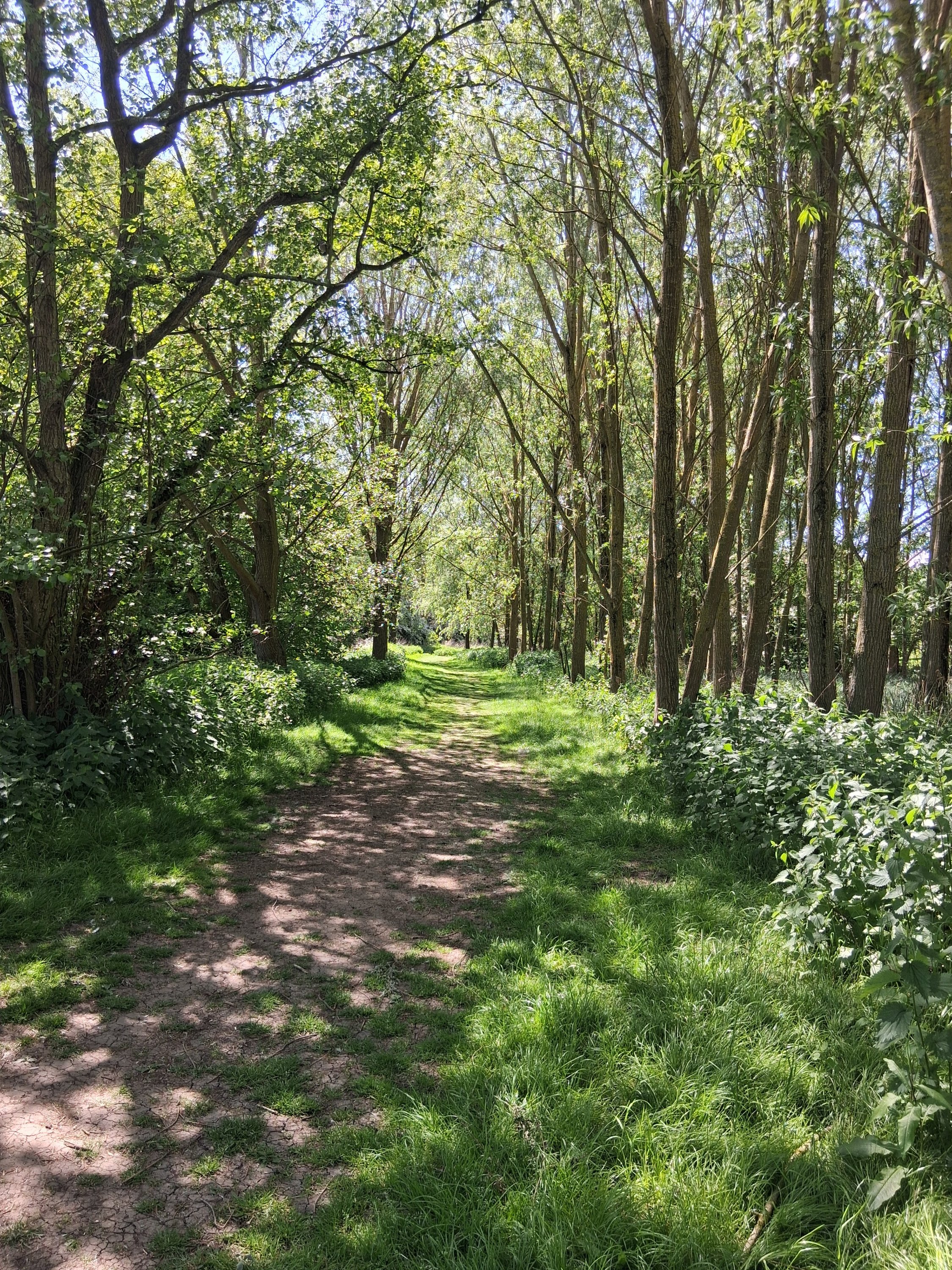
So, looking up the hill having visited the fantastic library, two tiny brown birds caught my attention as they at first landed on bushes near the river and then excitedly flew into the woods. I’m not good enough to identify them, but they lured me into Hoppit Mead, the park land at the bottom of our road. And that’s the picture you see at the head of this blog.
As I walked in, a troup of tiny Long Tailed Tits flew into the branches above. I became aware of their chattering and a new sound: the sound of the leaves flowing in the wind, a gentle rustling. As I walked on, a Speckled Wood butterfly flew up and danced its way through the shadows and the nettles. Gradually the road noise died away and as I looked up towards the houses that fringed the green I noticed an elderly person sitting in their front garden taking in the sun and the view.
Carrying on through the sounds took on a new importance.
Yes, Braintree is a busy town, and yes, both planes and traffic stream up the A120 corridor, but within easy reach, there is parkland, river walks, and pathways through trees.
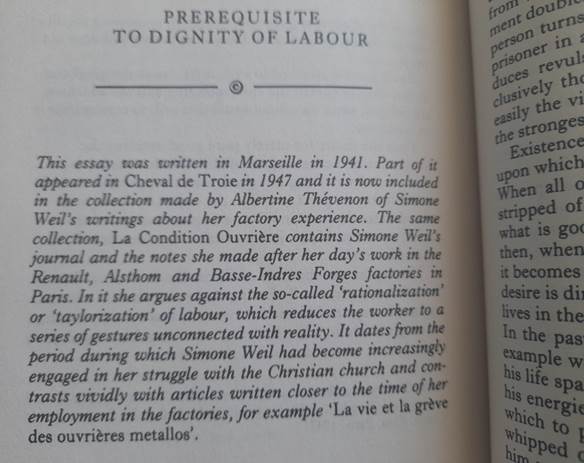
All of us suffer, and we all toil. Simone Weil points out that a great artist becomes more skilled, a business man becomes more wealthy and a politician gains more power as they succeed in their careers and they move on to greater things. For each a moving on brings wealth and renown on their field. A worker, a teacher, a farmer, remain in their toil, getting better at it brings no reward, and they can only move on by leaving their trade. For most of us there will be little scope for improvement in our lot unless we change jobs and it may be more of the same as we are subject to redundancy. We may even go backwards.
For most of the world, living from hand to mouth is their lot and we hope that the world will be fair to us and we will have clothes, food, good health and shelter. We also hope for justice, safety and the opportunity to learn.
We learn that this works when our community functions benevolently and that we are part of a community of communities that supports the individual and works towards the collective good.
A supermarket can model this being a placewhere communities intersect. It sells food, clothes and luxuries, and not only thrives at the price point, but succeeds when its staff is content and outward facing and the customers feel part of the whole, believing that all that they have has been produced and provided with kindness. Each of us trusts that no harm has been done and that care is taken so that the weak are provided for. Social capital and loyalty grow if allowed to and the supermarket prospers. It isn’t engineered it is a function of time and place. The store is a modern focus of communities and actually in the common mind held accountable to the common good. This may be a fiction but you see tokens collected for charity, food bank collections and innovations in waste disposal that benefit the locality. Local charities collect at the doors and family and friends gather for coffee. The superstore has become the market centre, which town centres struggle to retain.
Luxury items may be beyond the means of the workers who make them, the meal beyond the purse of the chef, the car beyond the wage of the chauffeur, the lifestyle choice beyond the salesperson.
All the worker can rest in is the the sense of having toiled well, a means to a greater end of having been good and faithful, or avoided penury. If our lot confines our purse but we are necessary to a function of wealth, we can also be happy if we feel part of something beautiful. Our participation brings us joy.
Beautiful things may be of immense value and costly. Refinement and detail has a price and wealth enables great artistry. For most fabricators, the high end taylor, the super car engineer, what they work on is beyond their purse yet without their skill there is no product. That is the nature of our culture; our wage is there because we serve other’s needs. We depend on what we produce. Our labour enriches our customers, our managers as well as ourselves in an organic system fulfilling grades of need. Even people of ideas need others to buy into them and pay.
We are not owned by others but we sell our labour, peddle our skills, and depend on the market to monetise our efforts. We may shy from calling customers our masters but in selling our labour we are always close to selling ourselves. By design the beauty that everything we make reflects, cannot be bought and is open to all and can result in wonder or envy.
Simone Weil points to beauty in the stars, architecture and liturgy, family and holidays. All nature is telling us something, darkness brings light and yes evil hides behind wonder and pretends to be light, but beauty is eternal, envy, jealousy and pride bring death. The consequences of evil persist and their cycle seem unending but as they bring death, if they are not fueled, they too die. Goodness brings their demise sooner.
Further, look at the life cycle of the large blue butterfly, an adult of great beauty whose caterpillar destroys a flower, drops to the ground and depends on tricking red ants into caring for it as a pupa which eventually eats the whole ant colony before becoming a chrysalis and emerging as an adult of great beauty.
Depending on our viewpoint this is horrific as a process or beautiful in its outcome. The butterfly is a parasite, its lifecycle intricate. Beauty depends on your gaze, the truth you hold. The butterfly is indeed beautiful. The lifecycle is in truth fascinating. Seeing the whole covers the detail.
Negotiating the path of life between suffering and plenty demands joy to draw us forward into right seeing. There has to be an eternal covering of all that holds us to the grind stone, envy and jealousy, a stopping and looking to take in the beauty that will remain with us forever. Joy draws us to this and enables us to be content, beholding a beauty all may see, and expand our gaze. We must strive to enable joy to work its alure, I suggest, and lead us along the narrow way that leads to life, to see beauty, truth and good and enjoy life as we are able. The gift I am coming to see is in the moment, the surprise of centering joy. Beauty takes its place on the throne of our hearts and can be shared in the most desperate of circumstances. This beauty is shared by all and binds us together in love. The truth of our way is made plane in love that draws on the ineffable and speaks through kindness and care, compassion and just action. Good times for all.
Ecclesiastes 2:24-26 NRSV
There is nothing better for mortals than to eat and drink, and find enjoyment in their toil. This also, I saw, is from the hand of God; for apart from him who can eat or who can have enjoyment? For to the one who pleases him God gives wisdom and knowledge and joy; but to the sinner he gives the work of gathering and heaping, only to give to one who pleases God. This also is vanity and a chasing after wind.
Power has at least two ways of working, by force or by persuasion. In the greek, Mark Vernon tells us there are two words (or four) most used for power in the bible, and the one used of Jesus (dunamis) is the power that flows and draws; the power in love, beauty and truth. The other word is the power of authority (exousia), the power of the powers in this earth that exert authority.
I have followed Mark from science cleric to atheist to Buddhist back to mystic Christian. It has always been at a distance, but recently, he has started making more sense.
In this podcast, he ends by critiquing Christianity as falling into the law based authority camp or the camp that grasps at the draw of beauty, the finaty, and finds the eternal. He is drawn to places, to people, and liturgy, that are alluring rather than compel.
Auguries of Innocence
By William Blake
To see a world in a grain of sand And a heaven in a wild flower, Hold infinity in the palm of your hand And eternity in an hour.
Auguries are portends or foretellings so the poem looks at the humanity that reacts to hurt and sees it as pointing forward to innocence or maybe to a restoration of innocence. Compassio then points to an other, draws us to innocence, our reactions to injustice, the caging of the beautiful and hamstringing of the strong point to a purer humanity. They draw us to beauty, truth and good.
Humanity is created male and female, the Image of God. Jesus is found in the beginning, the beginning where Wisdom is present, divine companion and creator.
Wisdom is one in the same as Christ, the Creator of all things. Jesus the Christ and Jesus our Wisdom are one: Jesus Christ is Jesus Sophia. Jesus is the incarnation of the Word, there from the beginning, the incarnation of Wisdom.
The incarnation of God is the incarnation of Wisdom that forms, fills and holds the world. This is Jesus, enfleshed in us; like us, the image of God but unlike us being God; calling us to become like God in the humanity we share.
The full counsel of God is found in Jesus dwelling in us, fully God, revealing beauty, justice and mercy. We know joy in one another and weep with the oppressed, called to loving action in the world, in acts of kindness and solidarity.
In all circumstances Jesus’s gift is Peace.
Wisdom is personified as a woman. Jesus is beyond gender yet he is woman incarnate and man, the Father, One in God. Jesus, the Son, is Jesus as Wisdom from the beginning. In his humanity he is a male and in his divinity, beyond male and female: fully woman and fully man yet more.
Just as Love is his essential being so is Wisdom, One with the Father. In Jesus we are formed and sustained. We feed on his milk comforted like new born babes, born into a world of light with strength for the day.
The Son and the Father dwell within us. In him and through him we have our being. As we turn our gaze to beyond the horizon of knowing, we glimpse the fullness of both male and female in him.
In him, we find the beginning of all things. Jesus reveals to us God and in him is both male and female held as one. Jesus is as much woman as man and more.
So how are we to name this? As much as we call Jesus our Christ and Jesus our Saviour, we could know Jesus better as we call on him as Jesus our Wisdom from the beginning, Word made flesh: Jesus Sophia. Peace be with you, go without fear, to love and serve in wisdom.
Jennifer G. Bird joins Jared and Angela Parker to bust the myth of “biblical” marriage. She dives into the ways scripture has been used to enforce traditional gender roles, the cultural assumptions embedded in biblical texts about marriage, sex, and property rights, and how these interpretations have influenced Christian thought.
Recently, I have been contemplating Matthew 7 with the guidance of Bonhoeffer’s Cost of Discipleship. To start at the end, we get the parable of the person building their house on the sand and the one building their house on the rock.
Matthew 7:24-27 NRSV “Everyone then who hears these words of mine and acts on them will be like a wise man who built his house on rock. The rain fell, the floods came, and the winds blew and beat on that house, but it did not fall, because it had been founded on rock. And everyone who hears these words of mine and does not act on them will be like a foolish man who built his house on sand. The rain fell, and the floods came, and the winds blew and beat against that house, and it fell—and great was its fall!”
In a way, it rounds off this whole section of teachings, but for me, it refers quite closely to the way through Chaperer 7.
The chapter begins by warning us not to judge others.
Matthew 7:1-2 NRSV “Do not judge, so that you may not be judged. For with the judgment you make you will be judged, and the measure you give will be the measure you get.
Bonhoeffer reminds us that the story of original sin was to pick fruit from the tree of the knowledge of good and evil. To believe ourselves to be the judge is not right as the place of judgement is the cross, and judgment is rightfully the Lord’s. We are to look on Jesus and see all else in relation to his love for all. We are not to judge but to love.
And then this peculiare saying;
Matthew 7:6 NRSV “Do not give what is holy to dogs; and do not throw your pearls before swine, or they will trample them under foot and turn and maul you.
Apt, in that through judging, we profane the holy; we despoil the revelation of truth that opens our eyes to the right way by misapplication of the truth spoken to us to others. In order to speak, we need to be humbled by the realisation of our own needs, else the measure we get hurts.
We move from judgement to trust. It is in our hearts to be right. In speaking our own righteousness, we get hurt. The true path is prayer, and with our creator, we can intercede creatively and be transformed and sustained and see things change.
The movement continues laying aside our desire to judge, to love prayerfully and compassionately with kindness.
Matthew 7:12 NRSV “In everything do to others as you would have them do to you; for this is the law and the prophets.
It’s how we are that leads others to a better way, not our judgement. That way leads only to violence, which is a wide path.
Matthew 7:13-14 NRSV “Enter through the narrow gate; for the gate is wide and the road is easy that leads to destruction, and there are many who take it. For the gate is narrow and the road is hard that leads to life, and there are few who find it.
And here Jesus makes it plain. Only the few will be able to hear this. We are called to be of the few. It is in the twos and threes that Jesus is present. The body of Christ is made up of the few, a community of small communities gathered around Christ. Jesus knows what is in people’s hearts, and Bonhoeffer refers us back to the temptation Jesus experienced in the dessert, to be popular, one leading many.
Matthew 7:15-16 NRSV “Beware of false prophets, who come to you in sheep’s clothing but inwardly are ravenous wolves. You will know them by their fruits. Are grapes gathered from thorns, or figs from thistles?
The temptations of being popular, gathered around strong leadership, have left thousands on the wrong side of the truth. It’s not the Law and the Prophets that lead us to God. This is death. Encountering Christ leads us to the Law and the Prophets, schooling us in love and opening our eyes to our own pride and arrogance, bringing life. We preach to those we love.
Matthew 7:21 NRSV “Not everyone who says to me, ‘Lord, Lord,’ will enter the kingdom of heaven, but only the one who does the will of my Father in heaven.
Our distinctive, Jesus teaches, is to love as Jesus loves, self sacrificially and without coercion. If we find ourselves distinct because of our judgement of others then however successful we may appear, we are wrong.
It’s a hard saying, and we are back to where we started; all these sayings are the foundation we build on for the day of trouble. To end at the start, Jesus, before he embarked on this section of teaching, said,
Matthew 6:34 NRSV [34] “So do not worry about tomorrow, for tomorrow will bring worries of its own. Today’s trouble is enough for today.
Listen and reflect on this detailed exposition of the idea and the faith that builds itself around rebirth. It opens up the idea and asks some profound questions around how pluralistic we actually are. Does the folk understanding of Karma conceal a deep division in the perception of reality? Is there a deep schism in the understanding of what is real? Is this one fairy too far?